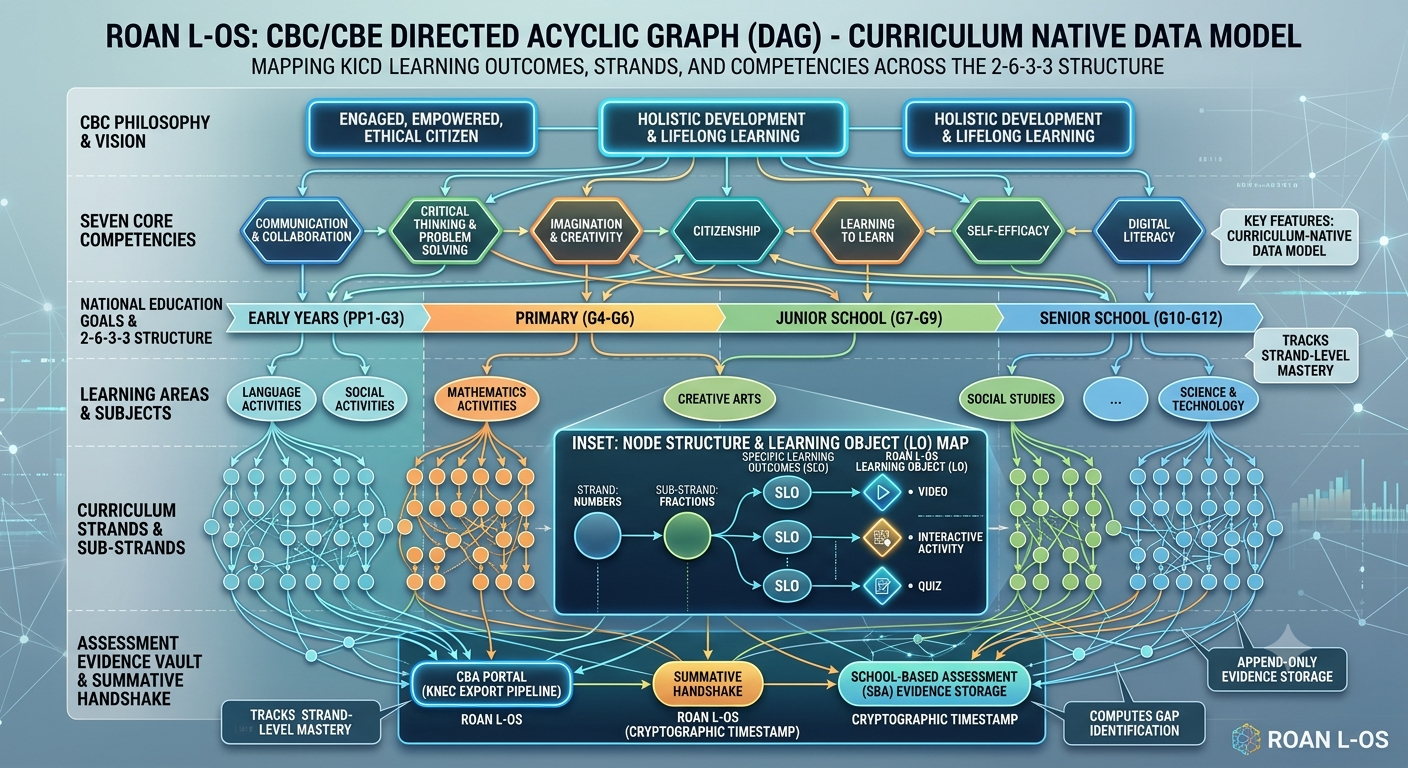
Competency-based assessment in Kenya is not a single thing. It is a layered architecture — three distinct assessment layers operating across four education tiers, each tier with its own weighting ratios, grading scales, national examination endpoints, and evidence requirements. Most education technology platforms treat assessment as a feature: a marks entry form, a grade-book, a report card generator. ROAN treats competency-based assessment as a structural property of the curriculum graph. Every tier, every layer, every ratio is encoded into the data model — not configured by an administrator, not entered by a teacher, but derived from the graph at runtime. This post explains what that architecture looks like and why it matters.
The Three Assessment Layers
Kenya's Competency-Based Curriculum Assessment Framework defines three distinct layers of assessment, each with a different owner, a different instrument, and a different purpose.
Layer one: Classroom Assessment
Classroom assessment is teacher-developed and runs continuously from PP1 through Grade 12. It is the most granular layer — teachers design their own tools (observation schedules, checklists, rating scales, portfolios, oral assessments, rubrics, projects, journals) and assess learners against specific learning outcomes throughout the year. This is not a formal examination. It is the ongoing process of a teacher observing, recording, and responding to where each learner stands against the curriculum.
In ROAN L-OS, classroom assessment maps to the formative assessment track. The assessed unit is the learning outcome — not the sub-strand, not the strand, not the subject. When a teacher opens the assessment interface, they see the sub-strand as a topic heading, with each learning outcome listed beneath it carrying its own competency-level selector. The teacher selects a level (Exceeding, Meeting, Approaching, or Below Expectation at PP1–Grade 9; one of eight sub-bands at Grade 10–12), adds a note, and seals the observation. Once sealed, it cannot be altered. This is the Summative Handshake's first input.
Layer two: School-Based Assessment
School-Based Assessment is KNEC-developed and applies from Grade 4 through Grade 12. KNEC designs the SBA tools and publishes them through the cba.knec.ac.ke portal. Each learner receives a Unique Pupil Identifier from Grade 3 onwards — a NEMIS or KNEC assessment number that links their SBA records across the school system. SBA contributes to national examination scores at different weights depending on the education tier.
In ROAN L-OS, SBA evidence is collected through the formative assessment track (teacher observations against learning outcomes) and structured for export through the Summative Handshake — a KIPI patent-pending system that packages sealed, timestamped competency evidence into KNEC-compliant SBA export records. The SBA export pipeline is aware of each tier's window structure: Junior Secondary has two SBA windows (Window 1 and Window 2) that contribute separately to the KJSEA score, and the platform manages the sequencing and evidence aggregation for each.
Layer three: National Summative Assessment
National Summative Assessment is KNEC-administered at three points in the 2-6-3-3 structure: KPSEA at Grade 6, KJSEA at Grade 9, and KCSEA at Grade 12. These are the terminal examinations for each education tier. A fourth national assessment — KEYA — runs at the end of Grade 3 (the Early Years Education tier), but it is non-ranking and purely diagnostic. No child's trajectory is determined by KEYA performance.
The summative track in ROAN L-OS handles marks entry and AI-generated narrative. For each term's summative assessment, a teacher enters a marks score for each sub-strand. The platform maps the mark to the appropriate competency tier (four-level for PP1–Grade 9, eight-level for Grade 10–12), generates an AI narrative organised by sub-strand, and seals the record. The narrative draws from both the formative observation record and the summative marks — the Summative Handshake synthesises both tracks into coherent, KNEC-aligned progress descriptions.
Assessment in Kenya's CBC is not marks in a gradebook. It is a structured evidence architecture — three layers, each serving a different purpose, all feeding a single national system. The platform must understand all three simultaneously.
The Four Education Tiers and their Weighting Ratios
Each education tier in Kenya's 2-6-3-3 structure has a distinct assessment weighting model, derived from KNEC specifications. In a curriculum-native platform, these ratios are properties of the curriculum graph — not configuration values that an administrator enters, but structural attributes of the tier node that every downstream feature inherits automatically.
Early Years Education (PP1–Grade 3) → KEYA Formative observation only. Non-ranking. The four-level competency scale applies (EE/ME/AE/BE), but results are never aggregated into ranked scores or league tables. KEYA at end of Grade 3 is diagnostic. No SBA weighting. No summative percentage. The assessed unit is always the learning outcome; reports describe individual competency patterns, not comparative performance.
**Upper Primary (Grades 4–6) **→ KPSEA 60% School-Based Assessment + 40% national summative. SBA evidence is drawn from formative observation records across the Upper Primary years, sealed per the Summative Handshake protocol, and exported to the KNEC cba.knec.ac.ke portal. The 60/40 split is a property of the Upper Primary tier node in the curriculum graph. When a teacher assesses a Grade 6 learner, the platform knows the correct weighting without being told.
Junior Secondary (Grades 7–9) → KJSEA 20% SBA Window 1 + 20% SBA Window 2 + 60% national summative. The dual-window SBA structure means the platform manages two separate evidence collection and export cycles before the Grade 9 terminal examination. Window 1 and Window 2 evidence are collected, sealed, and exported independently. The 20+20+60 split is a property of the JSS tier node.
Senior Secondary (Grades 10–12) → KCSEA 40% School-Based Assessment + 60% national summative. Within the SBA component, a further internal split applies: 30% formative and 70% summative. This means the platform must track two levels of weighting simultaneously for Senior Secondary learners — the tier-level SBA/summative split and the within-SBA formative/summative split. Both are properties of the SSS tier node. The eight-level grading scale (EE1 through BE2) also activates automatically when the isSSS flag is set.
Why the ratios must live in the graph
A curriculum-adapted platform stores assessment ratios as configuration values. An administrator opens a settings panel, enters "60" in the SBA field and "40" in the summative field for Grade 6, and saves. The platform stores the values and applies them when generating reports. If the administrator enters the wrong values, the platform does not know. If KNEC changes the ratio, every school's administrator must update their settings. If a school spans multiple tiers — say, a comprehensive institution offering PP1 through Grade 12 — each tier's ratios must be configured independently, and the platform must trust that they were entered correctly.
In a curriculum-native platform, none of this happens. The ratios are structural attributes of the tier nodes in the curriculum graph. When a Grade 6 assessment is generated, the platform traverses the graph, identifies the Upper Primary tier node, reads the SBA and summative weights, and applies them. No configuration required. No possibility of human entry error. No risk of drift between tiers. When KNEC updates a ratio, the graph is updated once and every school that uses that tier inherits the change immediately.
This is what it means for assessment to be a structural property rather than a configuration value. The structure is correct by construction. The platform cannot produce an incorrectly weighted assessment for a known tier, because the weighting is not a setting — it is part of the definition of the tier.
The Two Assessment Tracks in ROAN L-OS
ROAN L-OS implements assessment across two parallel tracks that feed a single evidence system.
The formative track
The formative track is weekly, teacher-driven, and continuous. The unit of assessment is the learning outcome. Teachers open the assessment interface, select the sub-strand they are covering in the current week (which the curriculum graph has pre-scheduled according to the teaching-week model), and assess each learning outcome individually. The competency level is recorded, the observation is dated and attributed to the teacher's account, and the record is sealed. Sealed records are immutable — they enter the evidence vault and cannot be modified.
The four-level scale (EE/ME/AE/BE) applies from PP1 through Grade 9. The eight-level scale (EE1/EE2/ME1/ME2/AE1/AE2/BE1/BE2, with corresponding grade points from 8 down to 1) applies from Grade 10 through Grade 12. The grading scale is not a setting the teacher selects. It is derived from the education tier of the learner being assessed — another property of the curriculum graph.
The summative track
The summative track produces marks and AI-generated narrative, organised by sub-strand. For each term's summative assessment, the teacher enters a marks score for each sub-strand they have taught in that term. The platform maps the mark to the appropriate competency level using the tier's grading thresholds, and triggers the AI narrative generation pipeline. The narrative is organised by sub-strand — the sub-strand functions as the spine of the narrative, synthesising the learning outcomes it contains into coherent prose. The AI draws from two sources: the sealed formative observation records for that sub-strand and the summative marks entry.
The AI narrative pipeline is curriculum-constrained. It generates content only for sub-strands that have been taught in the current term (as confirmed by the LPW delivery record) and only for the learner's identified competency position. It does not generate generic praise or generic deficit language. It describes competency — what the learner has demonstrated and where the next learning step lies.
The formative track records what a teacher observed, week by week. The summative track synthesises what a learner demonstrated, term by term. The Summative Handshake seals both into evidence the national system trusts.
The Summative Handshake
The Summative Handshake is ROAN's KIPI patent-pending protocol for generating KNEC-compliant SBA evidence from the platform's assessment records. It is the bridge between the two assessment tracks and the national SBA export pipeline.
At a conceptual level, the Summative Handshake works as follows. At the end of each assessment period, the system aggregates all sealed formative observations for a given learner in a given subject across a given term. It applies the tier's SBA weighting to determine how much the formative evidence contributes to the term's overall competency score. It combines this with the summative marks entry to produce a final competency determination for each sub-strand. It packages the result — with timestamps, teacher attribution, and curriculum graph identifiers — into a KNEC-compliant export record that can be submitted to the cba.knec.ac.ke portal.
The protocol is patent-pending for a specific reason: the integrity guarantees it provides are architecturally novel. Every sealed observation is timestamped at the moment of sealing. The timestamps are append-only — they cannot be altered after the fact. The evidence package presented to KNEC contains a complete, auditable chain of observation events, each linked to a specific learning outcome in the curriculum graph, a specific teacher account, and a specific date. Schools cannot retroactively adjust grades, because the evidence architecture does not permit it.
This matters for a system reason beyond individual school integrity. KNEC's SBA framework depends on the reliability of school-level evidence. If schools can alter their records after the fact, the national SBA score is not a measure of learning — it is a measure of administrative flexibility. The Summative Handshake removes that flexibility by design.
What this means for a school implementing CBC/CBE
For a school administrator, the assessment architecture means that every KNEC compliance requirement is handled structurally, not manually. The correct weighting ratios apply to every assessment. The correct grading scale activates for every tier. SBA evidence is collected in a format that the KNEC export pipeline can consume. The dual SBA windows for Junior Secondary are managed automatically. The eight-level grading for Senior Secondary activates when the school's tier flag is set.
For a teacher, the architecture means that the assessment interface presents exactly what the curriculum graph specifies is due for assessment in the current period. The teacher does not need to look up which sub-strands are in scope, which weighting applies, or which grading scale to use. The graph knows. The interface presents. The teacher assesses.
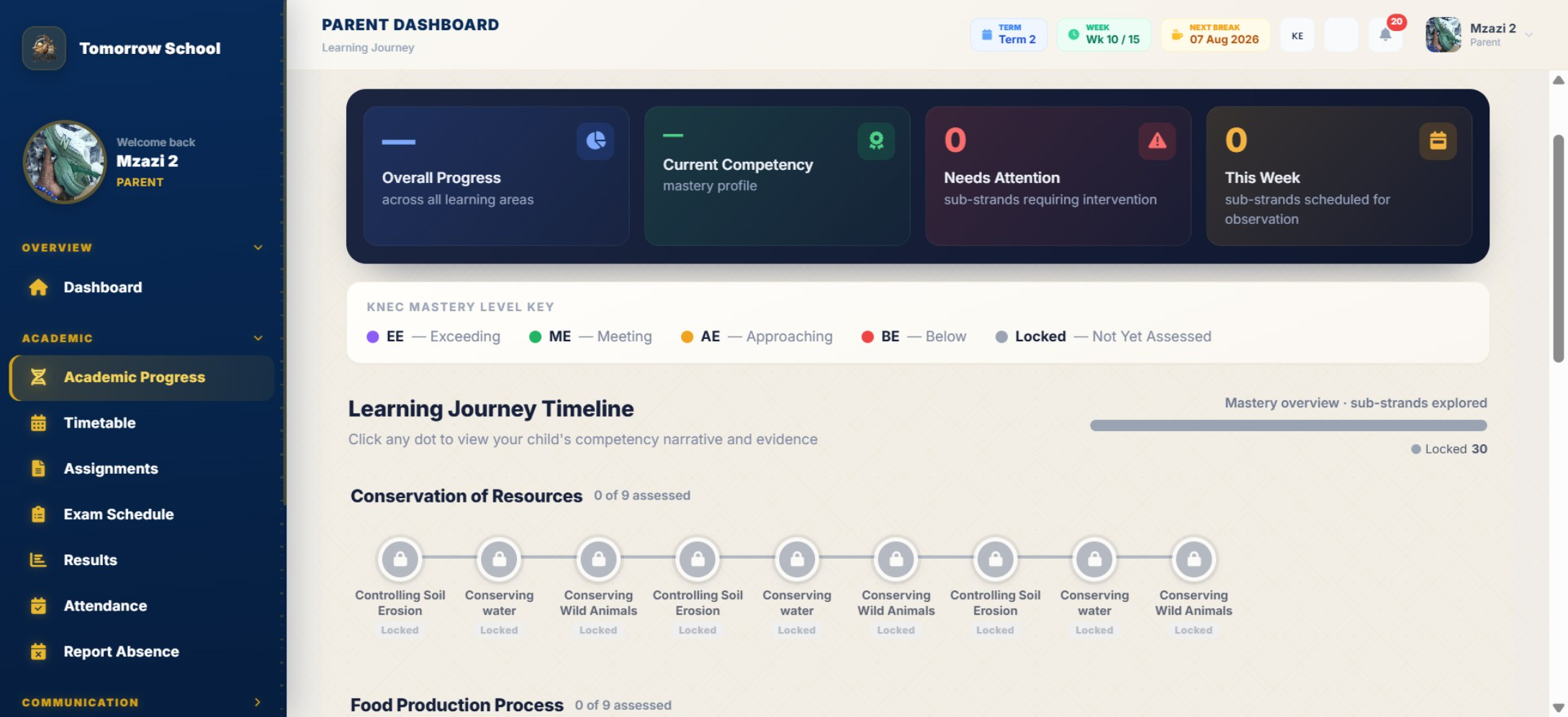
For a parent, the architecture means that the competency portfolio their child's teacher is building is a genuine record — sealed, timestamped, and structured against the actual KICD learning outcomes. Not a teacher's subjective impression entered into a free-text field. A structured, auditable, curriculum-grounded evidence record.
Getting assessment right in CBC is not a feature of a good platform. It is the prerequisite for everything else. A platform that gets the assessment architecture wrong produces evidence that cannot be trusted, compliance records that are vulnerable to manipulation, and progress reports that do not reflect what learners have actually demonstrated. ROAN's assessment architecture is built on the premise that Kenya's teachers, learners, parents, and national institutions deserve evidence that is correct by construction — not by hope.

ROAN Learning Designs
Building Kenya's sovereign learning operating system — CBC-native, curriculum-first infrastructure for every learner on the continent.
Get in touch